Disqualification, Resilience, and the Political Economy of Waste in Indian Handloom
I begin inside a house in which a loom stands. In much of handloom weaving in India, the house and loom are one structure: The loom is situated in the front room or courtyard, and the warp is stretched toward the light of the street. Weaving is an interior act. The weave is made from interior aspects like the body’s repetitive motions and the household’s routine. Before it becomes a commodity, the cloth is a type of dwelling, holding time as a room does.
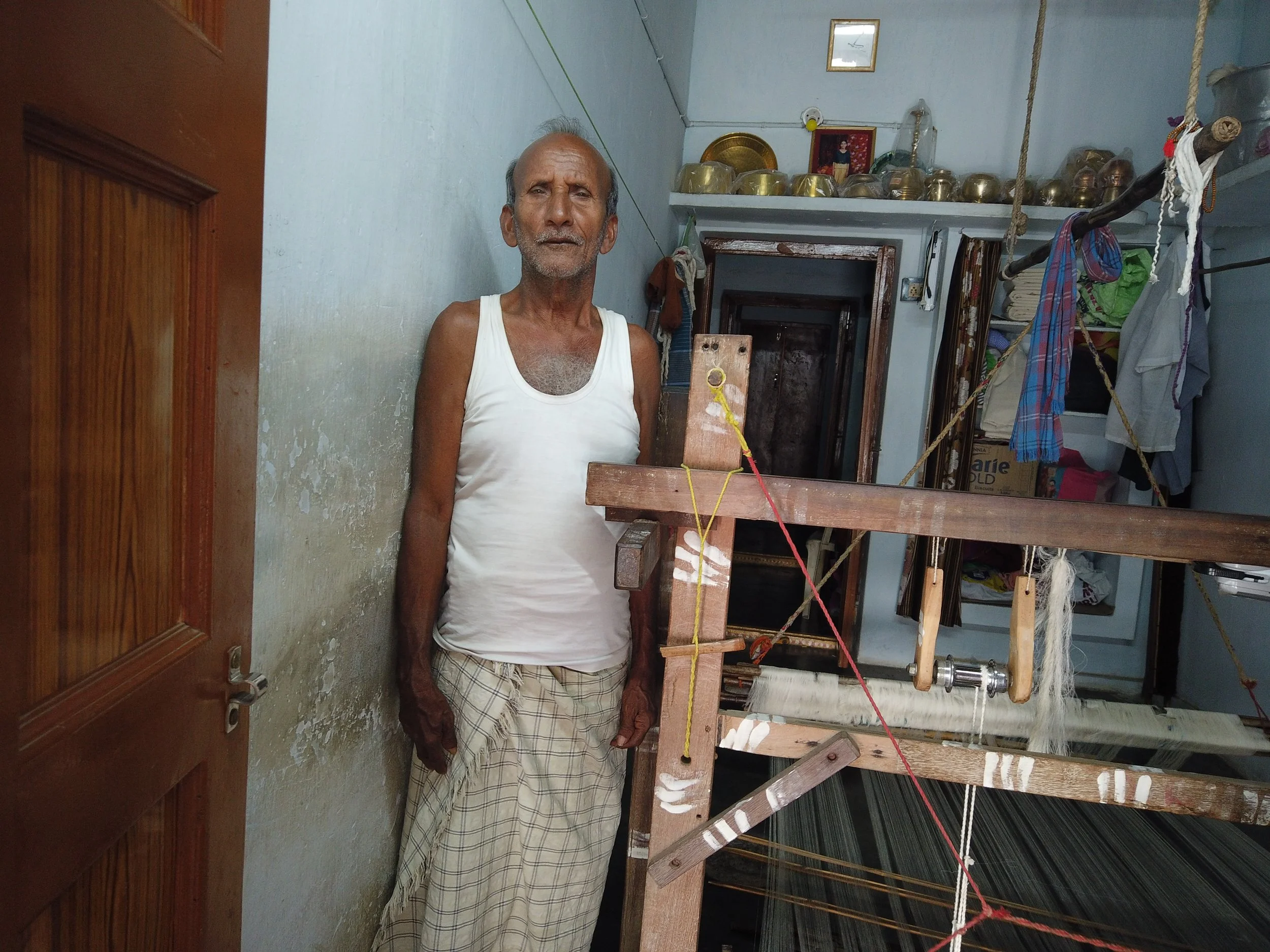
However, the cloth is made to leave. Every length must cross a threshold, and at that threshold stands authority. This dissertation is about that crossing and that threshold. It examines the moment when handwoven cloth crosses the threshold of the household in which it was made and moves to the market where it will be named, owned, or refused. Its empirical object is the reject: cloth that an authority declares to be a second, flawed, a misprint, or deadstock. Standards, such as the Handloom Mark and buyers’ specifications, exist but the decision to reject the cloth does not conform to any of them. It is a classification decision made by the party who holds the right to validate quality, often the master weaver or the society who is also the weaver’s creditor.
Weaving is a visual act. “Vision separates us from the world, whereas the other senses unite us with it,” Juhani Pallasmaa writes in The Eyes of the Skin. The weaver knows their cloth haptically. The weave’s tension, its weight, and its honesty are in their hands before being anywhere else. The rejection arrives in a different way: a glance, a distance, or a verdict. Nothing in the material changes at that moment; texture and weave remain as they were made. What changes is the cloth’s citizenship. It is expelled from one market and admitted to another. It is then renamed, reworked, and resold in parallel circuits as a second, a patch, or an upcycled piece at prices rarely seen by the weaver rarely and often captured by multiple players, including the same authority as was at the threshold.
The theoretical claim is that the control over this boundary between commodity and waste is a form of economic power in its own right that is not reducible to bargaining or prices. The sociology of valuation has revealed how goods are qualified, brought into markets, and given value (Karpik; Zuckerman; Espeland and Stevens; Callon). Studies on discard have reported that waste is made, not found (Gille; Liboiron; Reno). I develop a theory that is positioned between these theories: a theory of disqualification positioned at the threshold, not in the room. A low price can be contested, but rejected cloth has no price which can contribute to its appeal. The verdict is compounded through credit, since a weaver indebted to an authority cannot refuse the verdict without risking their next order. The verdict itself also creates value, removing the cloth from the weaver’s account and placing it once again on the other side of the door.
Threshold thinking also solves a puzzle. The Indian handloom industry has experienced shocks, from colonial deindustrialization to fast fashion, across two centuries. The census that certifies its survival also records its loss: approximately 6.5 million handloom workers in 1995–96, 4.3 million in 2009–10, and 3.5 million in 2019–20, of whom 2.7 million were weavers. A sector cannot simultaneously be resilient and impoverished by accidents. Its resilience is financed by the interiority of the labor, where the house is the shock absorber of the fashion economy. The rejection channel pushes loss both inward and downward, whereas credit eliminates outside options. In the deepest interior, the weaver performs rework at leisure at the loom’s edge, never entering the household or national accounts, quietly converting these rejects into objects of value. What development economics celebrates as resilience is the organized redistribution of loss from the world that judges to the home that absorbs.
The fieldwork follows the reject through three clusters, chosen as three architectures of the threshold. In Mangalagiri (Andhra Pradesh), the door is an institutional and cooperative, master-weaver arrangement that coexists in one fine-cotton region. Here, whether cooperative governance moves the right to judge closer to the hands that weave is tested. In Kutch (Gujarat), the urban world comes nearest. Bhujodi’s weaving is present within a dense design and revival economy where the reject’s second life is most visibly monetized and where circularity most risks capturing value beyond the weaver. In Majuli (Assam), a river island of largely women-led households weaving, loom and living under one roof, and the threshold remains almost entirely inside the house. This is the limiting case, where flooding and erosion set the rejection count alongside the market.
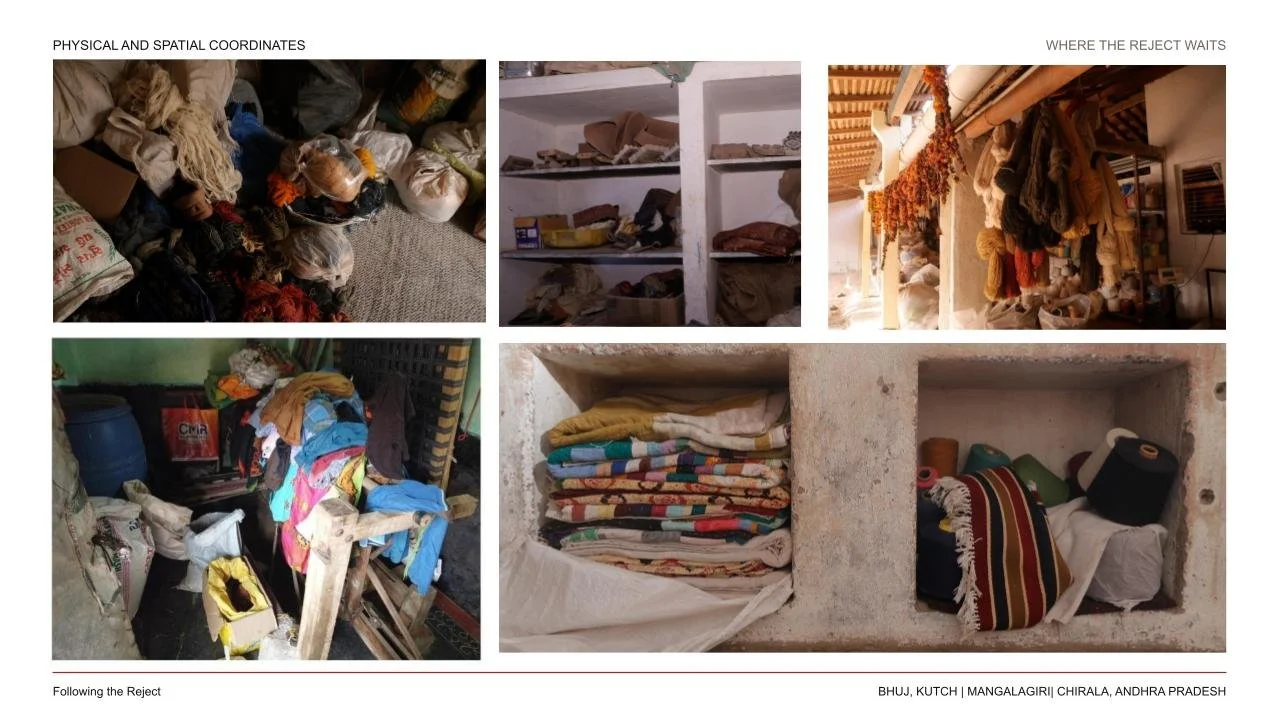
The spine is commodity tracing (Appadurai; Kopytoff), which follows rejected lengths of fabric from loom to final disposition, recording at each node the declared defect, the price offered or withheld, the rework, the captor of the second value, and the consequences for the cluster over time. Surveys of 225–300 weaver households, relational mapping of credit and kin, and time-use diaries that make the gendered subsidy countable are distributed around commodity tracing. Studies on commodity tracing have evaluated floor plans of loom, living, storage, and rework spaces because interiority here is not a metaphor but a plan, and whether a reject’s loop can close at home is partly a question of where the walls are. At the cluster level, I construct the reject reabsorption ratio: the share of rejected value recaptured within the cluster, as a diagnostic of a cluster’s path toward decline or resilience.
Rejection is a classification act that can be understood through the study of standards and categories (Bowker and Star; Busch) and through the paper trail that runs from the state’s handloom census and the market’s inspection books to the circularity certifications now defining waste from levels above the producer. It is an ethnographic object, traceable only through the relationships and discretion of informal markets, where no document records what a glance decides. It is also a historical act: Census rounds and two centuries of adaptation give the mechanism its depth in time. The project is essentially situated at the convergence of these mechanisms.
For years, I have run a design practice, buying rejected and deadstock handloom items from these chains, individual weavers, NGOs, traders, and wholesalers. What started as a pure adaptive reuse design response to rejected fabric has slowly transformed into an ethnographic object. I stand at the very threshold, and I treat that position as both a point of access and a liability.
A door decides who eats. This dissertation thus measures the door and asks what it would take, in credit, contestability, and the design of rework space, for the reject to be given a second life so that it can return home.