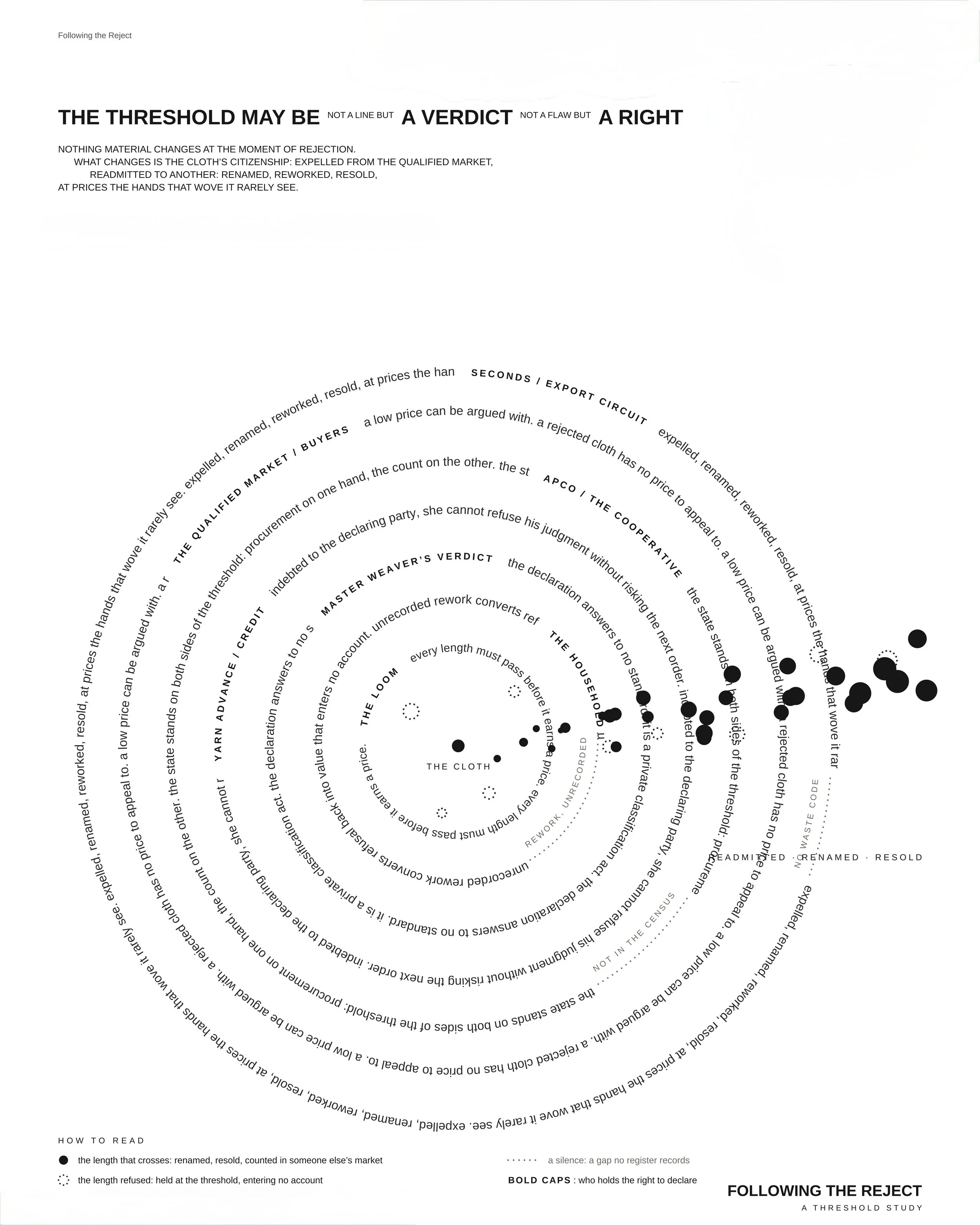
WHAT THE HOUSE HOLDS, A VISUAL ARGUMENT IN FOUR MOVEMENTS
Puzzle
The Indian handloom sector is among the most resilient craft economies in the world. Through two centuries of demand collapses, input-price spikes, mill and power-loom competition, liberalization, fast fashion, and climate shocks, millions of households still weave. Tirthankar Roy (1999) observed that this survival was never passive and its persistence is an institutional achievement. The sector is considered a success based on the standard measure of resilience.
However, counting instrument records reveal that success takes two forms. What the state counts through periodic national handloom censuses, are stocks: looms, weavers, allied workers, infrastructure, kilos of yarn, and exports. These numbers present a dual story-persistence on one side and decline on the other. The weaver count falls in every round-34.71 lakh in 1995-96, 29.09 lakh in 2009-10, and 26.74 lakh in 2019-20, with 3.5 million weavers decreasing to roughly 2.7 million. Reported output falls correspondingly. The same instrument certifies the sector viable even as its producers are unable to survive within it.
This is the puzzle: the handloom sector is simultaneously resilient and impoverished. A census of stock records what exists, not how it is funded. It can be both only if its resilience is financed by its members through an internal structure that converts pressure, regardless of its origin, into losses borne by those least positioned to refuse it. Therefore, the question is not how much shock can the sector absorb, but what is the standing mechanism by which loss is assigned inside the chain, who is authorized to operate it, and on what terms must those below accept its verdicts?
This mechanism is structurally invisible. Losses move through the chain continuously and quietly: the trader discounts, the master weaver takes a margin, the allied workers' piece rates are reduced, and the household adds an hour to the working day. None of this is recorded With one exception: once in each production cycle, a length of cloth is inspected, and someone with the authority to do so declares it a reject. Rejection includes a date, declaring party, stated defect, and price offered or withheld. It is the single point where the invisible act of assigning a loss becomes a discrete, recurring, and traceable transaction.
Therefore, this project follows the reject. Following the rejected cloth, the cluster's structure reveals itself-who holds the right to classify, under what conditions the judgment is made, what credit dependencies enforce it, into which unrecorded secondary markets the cloth travels, who reworks it, and who captures its second value? The puzzle is resolved not by counting what survives, but by exposing the mechanism that drives these decisions.